
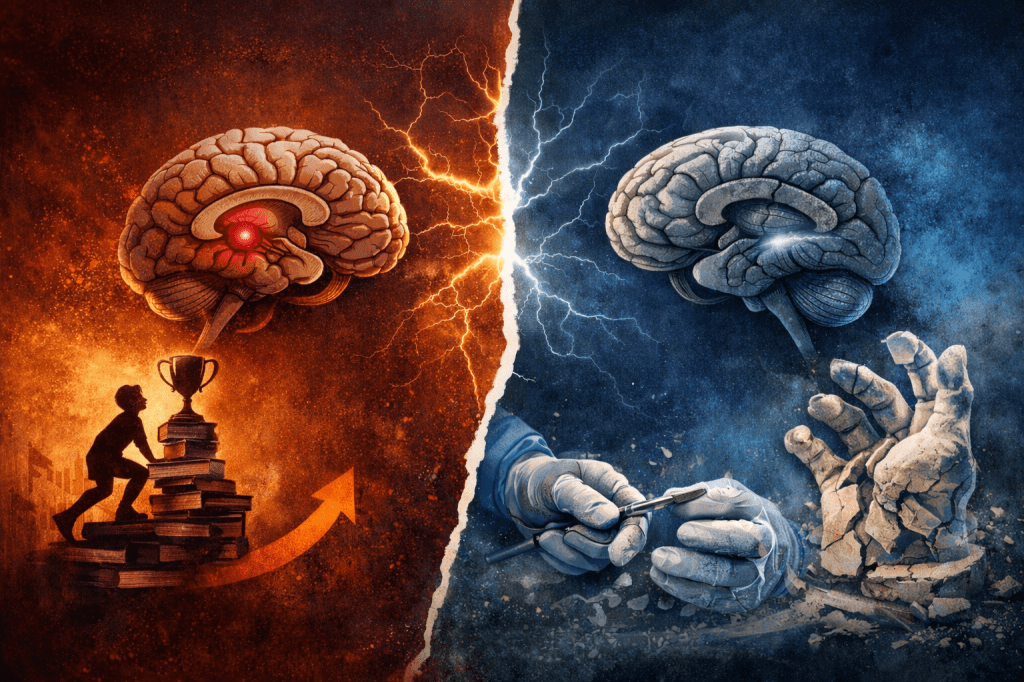
Some children grow up not under neglect, but under brilliance. Parents are accomplished, respected, visible. The home is materially secure, intellectually rich—and psychologically crowded. The child is not abandoned; they are overshadowed.
This produces a specific pattern: success driven by distress rather than choice.
Overshadowing: the invisible pressure
When parents are highly successful, three silent messages often form:
- Worth is conditional
Approval arrives after performance. Love is present, but admiration is earned. - Comparison replaces curiosity
The child learns how to match rather than who to become. - Failure is unsafe
Not because parents punish it, but because it threatens belonging and identity.
The child adapts intelligently. They excel.
Distress as a motivator
Under these conditions, achievement is not guided by interest or meaning. It is guided by relief.
- Relief from shame
- Relief from feeling small
- Relief from being invisible
This creates distress-driven success:
- High discipline
- High output
- Low internal satisfaction
Neuroscience and developmental psychology are clear on this:
When motivation is fear-based (loss of approval, loss of identity), the nervous system remains in a threat-regulated mode. Cortisol sharpens performance in the short term—but degrades creativity, flexibility, and health over time.
This is why many such adults look “successful” yet feel:
- chronically tense
- unable to rest without guilt
- panicked when progress slows
- empty after milestones
The system worked. Too well. For too long.
Overexpectation: the quiet inheritance
Parents may never explicitly demand more. But children internalize an idealized standard:
“I must be exceptional to be safe.”
This becomes self-policing. Even when parents step back, the internal pressure remains. The adult no longer works for the parents—but still works as if watched.
That is conditioning, not ambition.
Why it eventually breaks
Distress-driven success has a ceiling.
- It cannot tolerate uncertainty
- It cannot pause without anxiety
- It confuses rest with failure
When life introduces limits—health issues, relational demands, ambiguity—the old engine stalls. Burnout, identity confusion, or sudden disengagement follow.
This is not weakness.
It is a nervous system that was never trained for safety without performance.
Adult skill: a different requirement
High-level manual skills require:
- stable prefrontal regulation
- precise motor cortex timing
- sensory integration
- prediction and error correction
All of these collapse under threat.
When distress rises:
- the amygdala inhibits prefrontal cortex
- motor output becomes rigid
- hands shake, grip tightens, micro-adjustments vanish
- attention narrows instead of integrating
This is why:
- surgeons freeze
- artists lose flow
- hands “don’t obey” despite knowledge
The system has shifted from execution mode to survival mode.
Survival is fast.
Skill is subtle.
They are incompatible.
Why the old strategy no longer works
You are trying to use a threat-based engine for a cortex-dependent task.
That engine once pushed you forward because:
- tasks were simpler
- margins for error were larger
- adults compensated for you
- repetition mattered more than precision
Now:
- precision is the task
- errors are costly
- timing matters
- the cortex must stay online
Distress now disconnects the very circuits you need.
This is not loss of ability.
It is the wrong state.
A small but real way to break the pattern
Not a list. One correction.
Decouple safety from success—experientially, not intellectually
Understanding is insufficient. The body must learn a new association.
That means:
- Periods where nothing is achieved
- No optimization, no justification
- And nothing bad happens
Short, repeated exposures:
- stopping work before exhaustion
- choosing adequacy over excellence in low-stakes areas
- allowing someone else to be disappointed without rescuing it
Research on learning and conditioning is consistent:
New safety mappings form only through lived contradiction, not insight.
If rest does not lead to loss, the system updates. Slowly. Reluctantly. But reliably.
A final correction
If your success was built on distress, do not romanticize it.
It was adaptive once. It is costly now.
True maturity is not higher achievement.
It is being able to exist without proving.
That, ironically, is what allows sustainable excellence—this time chosen, not compelled.
 Chromfinite Journal
Leave a comment