
Fatty liver, belly fat, diabetes, PCOD – we are told these come from eating fat. But think carefully: in many Indian homes, people barely touch butter, barely eat ghee, even avoid oil – and still develop fatty liver. Something is not matching the story we have been told.
This article will uncover the process step by step – like a detective case. Not ideology. Not trend. Just biology.
1. Lifestyle Diseases: Why They Are Rising Even in “Low-Fat” Families
Look at a typical daily routine observed in offices and homes today:
- Wake up, tea + biscuits
- Breakfast: paratha or poha + chai
- Mid-morning snack
- Lunch: rice + dal + sweet
- Evening tea + snacks
- Dinner heavy, sleep late
- Sitting 10 hours
Notice something: fat is not the common thread. But frequent glucose hits are.
Yet society points fingers at fat because fat is visible. Biology, however, cares about molecules – not opinions.
2. How Disease Starts – The Universal Formula
Before naming the culprit, understand the general pattern behind almost every metabolic disease.
The body works by math:
More fuel entering than fuel getting used = pressure builds up.
Inside the body, pressure shows up as:
- Cells overloaded
- Insulin released again and again
- Liver turns extra fuel into fat
- Hormones shift
- Silent changes continue for years
- Finally symptoms appear – fatty liver, high sugar, belly fat, PCOD
Disease is not sudden. It is slow, invisible, mathematical overload.
3. Why Food Combinations Matter – The Biochemistry, Explained Simply
Many Indians consume refined glucose sources all day – chai, biscuits, rice, sweets.
When glucose enters the blood, insulin is released to push it into cells.
Fat by itself is neutral.
But fat + glucose eaten together is a trap.
Why?
- Glucose tells the body: “Store energy quickly!”
- Insulin locks fat inside fat cells
- Fat eaten along with glucose becomes priority storage
Example:
- Paratha (fat) + sugar chai (glucose)
- Chips (fat) + cola (glucose)
- Vada (fat) + sugary tea (glucose)
This explains why cutting fat alone never solved obesity or fatty liver.
It is the pairing and timing that decides whether fat gets used or stored.
4. Wrong Combinations – Everyday Mistakes That Look Innocent
| Habit | What Happens Internally |
|---|---|
| Tea + biscuits every evening | Sugar spike → insulin → body stores fat |
| Eating fruit right after meal | Adds sugar on top of glucose → overflow |
| Chips + soft drink | Fat trapped into storage |
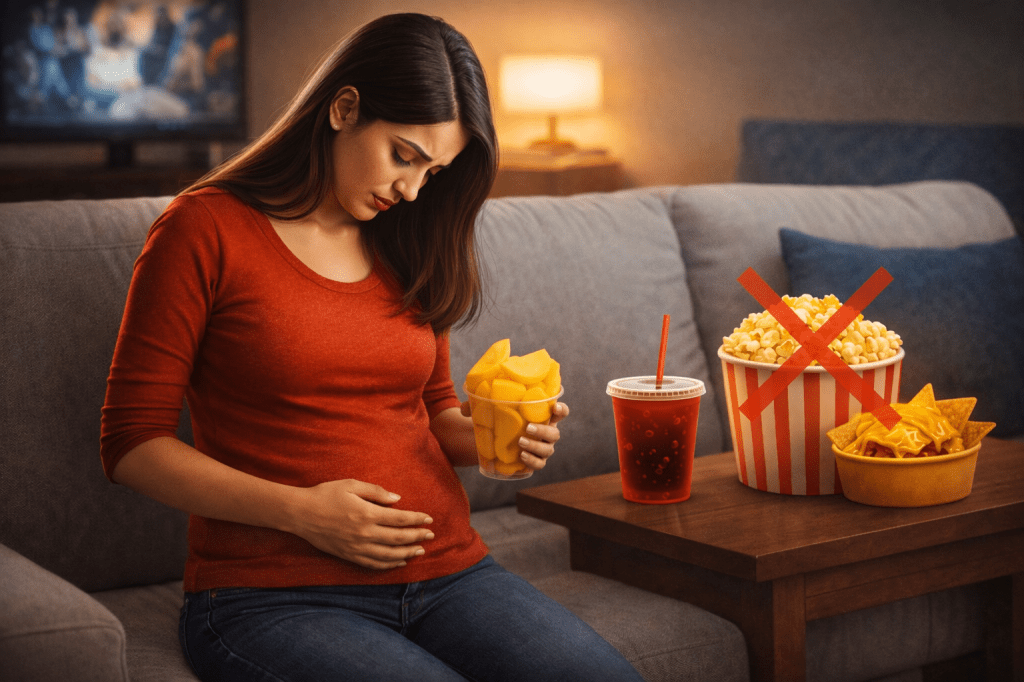
| Popcorn + sugary drink in theatre | Fast carbs + insulin spike = instant storage |
| Heavy dinner + immediately sleep | Glucose unused → liver converts to fat |
We do not need a moral lecture.
We need mechanical understanding.
5. New Rules (Not the Usual “Eat Fiber” Advice)
These rules assume cravings and impulses will not magically disappear.
We design strategy around human nature, not against it.
Rule A – Separate Pleasure Foods
If you will eat junk, eat it alone, not with a sweet drink.
- Popcorn alone OR cola alone – not together
- Samosa alone – without sugary chai
Spacing 1–2 hours reduces insulin stacking.
Rule B – Time Matters More Than Ingredients
Eating high-glucose food during the day is safer than late night.
- Morning glucose = body can burn
- Night glucose = liver will store
If you crave dessert, have it after lunch, not after dinner.
Rule C – Use Fat to Slow Glucose, But Never Mix With Sugar
A spoon of ghee on dal = fine
Ghee + laddoo = storage signal
Rule D – One Gap a Day
Make one 3-hour window with no calories – no biscuit, no chai, no milk, no fruit.
This gives your liver time to burn, not only store.
Rule E – 10-Min Walk Beats Any Superfood
Walk immediately after your heaviest carb meal.
Walking opens glucose gates without insulin.
Rule F – CBT Micro-Rules for Craving Resistance
Beck principle: cravings are thoughts, not commands.
When urge comes, ask:
- “Will this help my tomorrow or only my now?”
Then delay 10 minutes.
If craving still remains, eat with rule A and C applied.
6. Sugar and Carbs – The Hidden Operator
Instead of blaming fat, observe the pattern:
People do not get fatty liver from pure fat.
They get it from excess glucose repeatedly delivered to the liver.
The liver cannot say no. It must convert it.
And the fastest conversion pathway is:
extra glucose → triglycerides → liver fat
7. Conclusion – Stop Looking at the Wrong Enemy
Fatty disease is not a fat problem.
It is a timing problem, a pairing problem, and a demand–supply mismatch problem.
Your body is a bank:
- Glucose is deposit
- Insulin is the cashier
- Liver is the vault
- Fat is stored when vault becomes full
Instead of fighting cravings with guilt,
use strategy + science.
 Chromfinite Journal
Leave a comment